The Pyramid of Transformation
How to change your beliefs, redefine your identity and create lasting change — six levels, from environment to the Light, and why real transformation works from the inside out.

One of my favorite tools for understanding deep, lasting change is something I call the Pyramid of Transformation. It is a powerful framework that helps us understand the different levels of change we can work on, why some changes last while others don't, and why so many people find themselves repeating the same patterns even when they desperately want something different.
Often, people come to me looking to fix something specific. They want a better job, a better relationship, more money, a healthier body, or a different environment. They imagine that if they could just change one thing, everything else would fall into place.
If they had a different boss, they wouldn't be so stressed. If they moved to another city, their financial situation would improve. If they found a new partner, they would finally experience a happy relationship. If they changed their appearance, people would perceive them differently.
And, sure, sometimes changing external circumstances is exactly what we need. There are situations where leaving a job, moving to another country, ending a relationship or changing our social environment can make an enormous difference.
But there is something we often overlook: we can change our external circumstances without changing the internal patterns that created our experience in the first place.
And when that happens, we may find ourselves recreating the same problems in a completely different environment.
The Pyramid of Transformation helps us understand why.
Where Does the Pyramid Come From?
The concept of logical levels of learning and change has its roots in the work of anthropologist Gregory Bateson, who explored different levels of learning and how changes at one level can influence other levels of a system.
The framework was subsequently adapted and developed within Neuro-Linguistic Programming (NLP), particularly through the work of Robert Dilts, who popularized the idea of logical levels of change.
The version I use in my coaching and psychological practice is an adaptation of this framework. I have organized it around six levels, adding a spiritual dimension that connects our personal transformation with something greater than our everyday identity.
The central idea is that different levels of our lives influence one another, but they don't all have the same depth of impact.
A change in our environment might temporarily influence our behavior. But a change in our beliefs and identity can influence the way we make decisions, the habits we develop, the people we choose to surround ourselves with and the opportunities we recognize.
“If you want real, long-lasting change, you need to work from the inside out.”
Let's explore the six levels.
The Six Levels of the Pyramid of Transformation
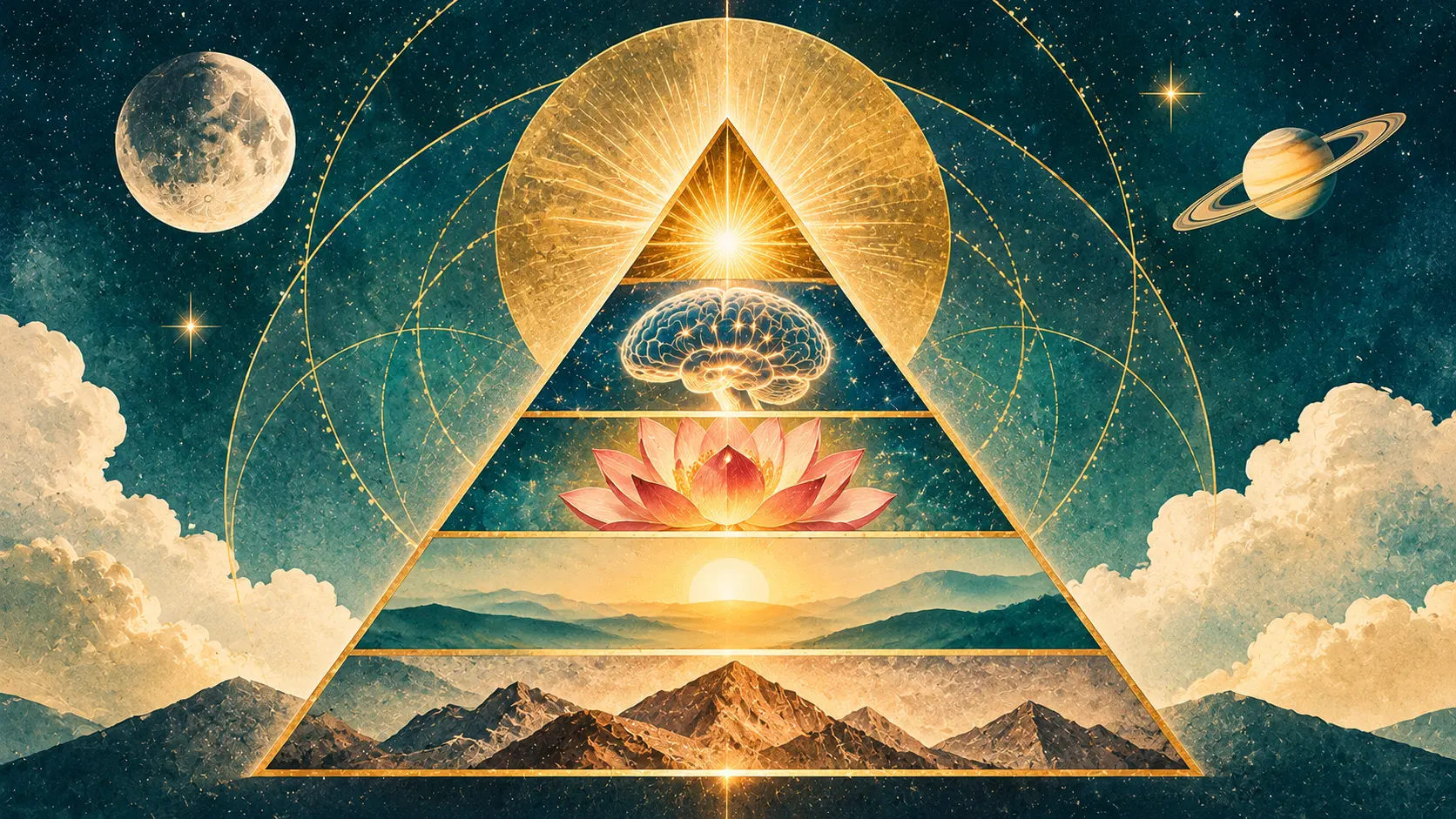
1. Environment – Where and When Do I Do It?
The environment is where most people initially think change happens.
It includes the physical world around us:
- The city and country where we live.
- Our home and workplace.
- The people we spend time with.
- Our friends, colleagues and social circles.
- The places we visit and the activities we participate in.
- The physical conditions of our daily lives.
Many people believe that changing their environment will automatically change their lives.
They imagine that moving to another country will make them happier, finding a new job will solve their problems, or surrounding themselves with different people will transform their personality.
But what happens when we move to a new city and take our old habits, fears, beliefs and expectations with us?
We might find ourselves experiencing the same situations all over again.
This doesn't mean that our environment is unimportant. Quite the opposite. Our environment can strongly influence our behavior, opportunities and everyday experiences. But if it doesn't support the person we are trying to become, maintaining transformation becomes much more difficult.
Imagine trying to develop a healthier lifestyle while spending all your time with people who don't value health, living in an environment that encourages unhealthy habits and constantly exposing yourself to situations that contradict your goals.
You will be like a fish swimming against the mainstream, moving in the opposite direction of the river.
So, if you want to change your environment, start asking yourself:
- Does my home support the person I want to become?
- Do the people around me reflect the values I want to develop?
- Where do people with the lifestyle I desire spend their time?
- What places, communities and experiences could introduce me to a different way of living?
Sometimes, changing our environment becomes much easier once we change our habits. As we start doing different things, we naturally begin visiting different places, meeting different people and discovering new opportunities.
Our external world gradually starts reflecting our internal changes.
2. Habits – What Do I Do?
Habits are the things we do repeatedly, often without consciously thinking about them.
Our daily routines, the way we treat our bodies, how we spend our money, how we communicate, how we react to difficult situations, the way we walk, speak and dress.
Even what we consider our minimum standard of living is connected to our habits.
Let's take fitness and weight loss as an example.
Millions of people sign up for gyms, hire personal trainers, buy expensive supplements and start strict diets. They begin with enormous motivation, determined that this time everything will be different.
And then, a few weeks or months later, they gradually return to their old routines.
Why?
Because wanting something and truly prioritizing it are two different things.
You might say you want to be fit, but deep down, you value comfort and convenience more. You might want to eat healthily, but you haven't yet developed the belief that you are someone who genuinely takes care of their body.
You might even be doing it because you feel you have to, because society tells you that you should, or because you are unhappy with your appearance.
But when the motivation disappears, what happens?
You return to what is familiar.
“A habit that is not supported by your internal values will eventually become a struggle.”
The same applies to almost every area of life.
You can buy beautiful clothes, start wearing perfume, change your hairstyle and experiment with makeup. But if you are still operating from beliefs that make you feel unworthy, insecure or dependent on external validation, changing your wardrobe alone won't create a lasting transformation in your self-image.
External changes can support an internal shift, but they cannot replace it.
This is why I always encourage people to look beyond the action itself.
Instead of asking only, "What do I need to do differently?", ask:
"Who is the person for whom these actions are natural?"
Because when a behavior becomes aligned with your identity and values, it stops feeling like something you constantly have to force yourself to do.
3. Values – What Is Truly Important to Me?
Now we move one level deeper.
Our values represent what we consider important in life. They influence our priorities, decisions and the way we allocate our time, energy and resources.
Some people value health, others prioritize freedom, financial security, family, adventure, recognition, connection, creativity or personal development.
There is nothing inherently wrong with having different values. The important thing is understanding what you truly prioritize, rather than what you think you should prioritize.
For example, you might say:
"I value health."
But when you look at your daily choices, you repeatedly sacrifice sleep, avoid movement, neglect nutrition and spend very little time taking care of yourself.
You might say:
"I value financial independence."
But you avoid learning about money, postpone important financial decisions and continuously spend without considering your long-term goals.
Or perhaps you say:
"I value meaningful relationships."
But you repeatedly invest your time in relationships where your needs, boundaries and emotions are not respected.
What is happening here?
There is a discrepancy between your declared values and your actual priorities.
And this is where the pyramid becomes particularly useful.
“Our habits are strongly influenced by what we value.”
If you want to change your habits, you need to examine what you are prioritizing and why.
Ask yourself:
- What do I truly value?
- Where does my time go?
- What receives most of my attention?
- What am I sacrificing to maintain my current lifestyle?
- Are my daily decisions aligned with the life I say I want?
Sometimes we discover that we are not actually living according to our values. We are living according to our fears, conditioning, social expectations or unconscious beliefs.
And this brings us to the next level.
4. Beliefs – What Do I Believe?
This is where the deeper psychological work begins.
Our beliefs are the ideas and assumptions we hold to be true about ourselves, other people and the world around us.
Some beliefs support our growth. Others limit our perception of what is possible.
For example:
- "I am capable of learning new things."
- "I deserve to be loved."
- "Money is difficult to earn."
- "Successful people are selfish."
- "I am not good enough."
- "I always sabotage my opportunities."
- "People like me never become successful."
- "If I make a mistake, people will reject me."
These beliefs influence how we interpret situations, what opportunities we recognize, what risks we are willing to take and how we behave when things become uncomfortable.
Imagine two people receiving the same professional opportunity.
One believes that they are capable of learning and growing. They might feel nervous, but they accept the challenge.
The other believes they are not qualified, that they will probably fail and that someone else deserves the opportunity more.
They might reject it before even trying.
The external situation is identical. Their internal interpretation is different.
And that interpretation influences their behavior and, consequently, the results they are likely to experience.
This is why I believe that working with beliefs is one of the most important parts of personal transformation.
But there is something else we need to understand.
“Not all our beliefs exist at the conscious level.”
You might consciously believe that health is important, that you deserve success or that you are worthy of love.
You can repeat these affirmations every morning, write them in your journal and put them on your bedroom wall.
But what happens if, on a subconscious level, you carry completely different beliefs?
For example:
"I don't deserve to be successful."
"Being healthy requires too much sacrifice."
"If I become successful, people will judge me."
"If I have more money, I will lose my freedom."
"If someone loves me, eventually they will abandon me."
These beliefs might have developed through childhood experiences, family dynamics, cultural conditioning, painful relationships, repeated disappointments or other significant experiences.
They can operate silently in the background, influencing our reactions without us even realizing it.
It is like planting flowers in a garden that is already full of weeds. You can plant as many beautiful seeds as you want, but until you address the old roots that are taking up space, the new plants will struggle to grow.
This is where the real battle with the shadow takes place.
The first step is awareness. We need to identify the beliefs that are operating beneath our conscious intentions.
Then comes the work of questioning them, understanding where they came from, recognizing how they have influenced our decisions and gradually developing new, more supportive ways of thinking.
It is not enough to say a new belief once or twice and expect everything to change.
Real transformation requires persistence. It means noticing when the old belief appears, questioning its validity and consciously choosing a different response.
And because subconscious beliefs are often connected to emotions and personal experiences, this work isn't simply intellectual.
We need to engage our emotional world, too.
We need to learn not only to think differently, but also to experience ourselves differently.
5. Identity – Who Am I?
Now we arrive at one of the most powerful levels of transformation.
Identity.
Who do you believe you are at your core?
How do you define yourself?
Are you someone who is successful or someone who constantly struggles? Are you someone who deserves love or someone who has to earn it? Are you someone who creates opportunities or someone who waits for life to happen?
Our identity is influenced by our past experiences, upbringing, relationships, culture, beliefs and the stories we repeatedly tell ourselves.
And sometimes, without realizing it, we become attached to an identity that no longer serves us.
We identify with being the victim, the unsuccessful one, the person who never finishes anything, the person who always has bad luck, the person who cannot maintain relationships or the person who has to struggle for everything.
The interesting thing is that once we identify with a particular version of ourselves, we often begin behaving in ways that confirm that identity.
If I believe I am someone who never finishes what I start, I might abandon a project the moment it becomes difficult.
If I believe I am not worthy of love, I might repeatedly choose relationships that reinforce that belief.
If I believe I am not capable of financial success, I might avoid opportunities that require me to step outside my comfort zone.
And then I look at the results and say:
"See? I knew it. This is just who I am."
But is it really who you are?
Or is it simply an identity you have learned to inhabit?
This is where the work becomes exciting.
Because we can begin questioning the stories we have accepted about ourselves.
We can choose a new identity.
Not by pretending to be someone we are not, but by consciously developing qualities, beliefs and behaviors that reflect the person we want to become.
Ask yourself:
- Who do I believe I am?
- What labels have I given myself?
- Which parts of my identity were formed by other people's expectations?
- What version of myself am I ready to leave behind?
- Who would I become if I stopped identifying with my limitations?
A very important part of transformation is understanding that you don't have to remain loyal to an old version of yourself simply because you have been that person for many years.
You are allowed to grow.
You are allowed to change your mind.
You are allowed to redefine yourself.
And sometimes, the most important decision you can make is to stop repeating the story that keeps you small.
6. Spirituality – Reconnecting With the Light
Above identity, I have added one more dimension: the spiritual level.
This is where we reconnect with something greater than our everyday personality, our circumstances and the limitations we have accumulated throughout our lives.
For me, this is the level of the Light.
The understanding that, at our core, we are connected to a source of goodness, generosity, abundance and infinite potential.
In Kabbalistic language, we can explore this through the relationship between the Light and the vessel, the desire to receive and the process of transforming our consciousness.
The Light represents the source of goodness and giving. Our work is to develop the capacity to receive that goodness and express it through our lives.
But sometimes our own shadow stands in the way.
Our fears, limiting beliefs, resentment, jealousy, shame, guilt and feelings of unworthiness can prevent us from experiencing the fullness of what is available to us.
The important thing is to understand that you are not your shadow. You are here to transform it.
Your shadow is not your ultimate identity. It is part of the work you are here to do.
And this is where personal responsibility becomes essential.
We cannot always control what happens to us, what other people do or the circumstances into which we are born.
But we can take responsibility for how we respond, what we choose to believe, what we develop and the direction in which we want to grow.
The first belief I want you to reconnect with is that the Light is good.
That it is benevolent, generous, just and merciful.
When you begin to understand these qualities, you can start asking yourself how to embody them in your own life.
How can I become more generous?
How can I practice more compassion?
How can I bring more justice into my decisions?
How can I become a source of goodness for others?
Transformation is not simply about receiving more. It is also about becoming someone who can express more goodness in the world.
And the more shadow we transform into light, the more light we can contribute to the collective.
Why Transformation Sometimes Feels Like Your Life Is Falling Apart
When I work with coaching clients, I always warn them:
“Be careful what you wish for.”
Because deep transformation doesn't simply bring new things into your life. Sometimes, it dismantles the things that no longer belong there.
When you start changing your beliefs and identity, you might discover that certain relationships, environments, routines and even ambitions are no longer aligned with who you are becoming.
You might outgrow old friendships.
You might realize that your current job no longer fulfills you.
You might recognize that a relationship is built around an identity you no longer want to maintain.
You might find yourself questioning everything you previously considered important.
And this can be uncomfortable.
Sometimes it feels like loneliness. Sometimes it feels like confusion. Sometimes you wake up and think:
"What is happening to my life? Everything is changing!"
But what if this isn't necessarily destruction?
What if it is the space between the old and the new?
There is always a cycle of creation and transformation. Just as we need to make space for something new, we sometimes need to release what no longer supports our growth.
In spiritual language, we can describe this as allowing the shadow to dissolve so that more light can emerge.
And this is why I always encourage people to be patient with themselves.
You don't need to change everything overnight. You don't need to abandon everyone, quit your job or move to another country to prove that you are transforming.
Sometimes the most important changes happen quietly, through the decisions you make every day.
But don't be surprised if, as your internal world changes, your external world starts changing too.
A Lesson From Pretty Woman: Can We Change Our Identity?
I personally learned about the Pyramid of Transformation from my Russian psychologist teacher, who introduced it during a two-day seminar dedicated to how women create lasting change.
One thing I particularly appreciate about Russian psychologists is that they can be very bold, direct and memorable in the way they explain psychological concepts.
And, to help us understand the pyramid, one of our homework assignments was to watch the famous Hollywood movie Pretty Woman, starring Julia Roberts.
At first glance, it is simply a romantic comedy about a woman who dreams of changing her life and leaving her profession.
But if we watch it through the eyes of a psychologist looking for the different levels of the Pyramid of Transformation, something interesting happens.
At the beginning of the movie, Vivian's environment, habits, appearance, relationships, values and self-perception reflect the life she has become accustomed to.
As the story progresses, she is introduced to a different environment, different experiences and people who expose her to new possibilities.
She begins experimenting with different behaviors, discovering new standards and questioning what she believes she deserves.
Gradually, her self-perception changes.
By the end of the movie, we see a woman who relates to herself and her possibilities differently.
Of course, Pretty Woman is a fictional story, not a psychological case study. But it provides an interesting illustration of how different aspects of identity, behavior and environment can interact during a person's transformation.
And I think this is why it makes such a memorable example.
If you watch it again, try identifying the different levels of the pyramid as the character develops.
You might discover that you are watching a story about much more than a change of wardrobe.
The Lawyer and the Prostitute Story: Is It Really About the Clothes?
There is another story I encountered through the teachings of Russian psychologists that illustrates the relationship between identity and external appearance.
It is sometimes presented as an experiment involving two groups of women.
The first group consisted of five highly educated, ambitious and independent female lawyers who regularly dressed professionally.
The second group consisted of five women working in prostitution, who were described in the story as having a very different social and educational background.
The women were asked to exchange their clothes.
The lawyers dressed in provocative outfits, including mini-skirts, high heels and bold lipstick.
The other women wore elegant, conservative professional suits.
Then, according to the anecdote, both groups were sent to a bar to observe how men interacted with them.
The story claims that the men continued to approach and perceive the women differently, despite the exchange of clothing.
The lawyers were supposedly treated with respect, while the other women continued to receive flirtatious attention.
The explanation offered was that people were responding not simply to their clothing, but to the way they carried themselves, their behavior and their sense of identity.
I have not been able to establish an original scientific publication or independently verify that this experiment actually took place. So I would treat it as an illustrative story rather than scientific evidence.
Nevertheless, it raises an interesting psychological question:
How much of the impression we create comes from our external appearance, and how much comes from our behavior, nonverbal communication and self-perception?
Psychological research on clothing and nonverbal communication suggests that both matter.
What we wear can influence how we feel and how others perceive us. Our posture, facial expressions, gestures, voice and behavior also contribute to the impression we create.
Two women can wear exactly the same clothes and communicate very different things.
The deeper lesson is not that people will always treat us according to our internal identity. Other people's judgments are influenced by their own expectations, stereotypes and assumptions, too.
The lesson is that changing our appearance alone does not necessarily transform the way we experience ourselves.
You can buy the most beautiful clothes, change your hairstyle, wear expensive perfume and create a completely new external image.
But if you continue to believe that you are not worthy, not powerful or not deserving, you may continue making choices that reinforce those beliefs.
“Your identity influences the way you show up in the world. And the way you show up influences the experiences you create.”
How to Create Real Change Using the Pyramid of Transformation
Now that we understand the different levels, let's look at how to apply the pyramid in everyday life.
My recommendation is to begin at the highest levels and work your way down.
Instead of starting by asking what you want to change externally, start by defining the person you want to become.
Step 1. Reconnect With Your Highest Self – Change Your Identity
Who do you want to be?
Not simply what do you want to have, achieve or experience, but who do you want to become?
Imagine yourself living the life you desire.
How does this person think?
How does this person make decisions?
How does this person communicate?
What standards does this person maintain?
What do they no longer tolerate?
Remember that at your core, you are connected to the Light. You are not limited to the identity you have developed through your past experiences.
You have the capacity to grow, transform and reveal more of your potential.
Step 2. Change Your Identity – Question Your Beliefs
Once you have identified the person you want to become, examine the beliefs that support your current identity.
Ask yourself:
- What do I believe about myself?
- Do I believe I am powerful, abundant and deserving?
- What beliefs are preventing me from becoming this person?
- What am I afraid will happen if I change?
- What old stories am I still repeating?
For example, if you want to become financially successful but believe that money is difficult to earn, that successful people are selfish or that you are not capable of managing wealth, these beliefs deserve your attention.
Don't simply replace them with positive affirmations.
First, understand where they come from and how they have influenced your decisions.
Then begin developing new beliefs that are more supportive of the person you want to become.
Step 3. Change Your Beliefs – Realign Your Values
Once you start questioning your beliefs, examine your priorities.
If you believe that your health matters, are you actually prioritizing it?
If you believe that freedom is important, are your decisions creating more freedom?
If you believe that meaningful relationships are essential, are you investing in people who share that intention?
Your values should reflect the beliefs you want to live by.
This is where you begin creating internal consistency.
Step 4. Change Your Values – Transform Your Habits
Now translate your new priorities into everyday actions.
If you value health, create habits that support your body.
If you value financial independence, develop habits around learning, saving and managing money.
If you value personal growth, dedicate time to reading, studying, reflecting and developing new skills.
Don't underestimate small, repeated actions.
You don't need to become a completely different person tomorrow.
You need to start behaving in ways that reinforce the identity you are developing.
Step 5. Change Your Habits – Transform Your Environment
As your habits change, your environment can gradually change with them.
You might discover new communities, meet different people, visit new places and create a home that reflects your priorities.
Declutter your space.
Create an environment that encourages the behaviors you want to maintain.
Spend more time with people who inspire you to grow.
Put yourself in situations where your new habits become easier to practice.
Eventually, your external environment can become a reflection of your internal transformation.
And this is where the pyramid becomes visible in everyday life.
Your internal changes begin expressing themselves through your actions, your choices and the world you create around you.
Why Changing Your Beliefs Is Not Always Easy: The Growth Mindset
There is one more psychological concept that I find particularly important when working with the Pyramid of Transformation.
It is the concept of the Growth Mindset, developed and researched by psychologist Carol Dweck.
Some people have what is called a fixed mindset. They believe that their abilities, intelligence and personal characteristics are largely fixed.
They might say:
"I'm just not good at mathematics."
"I'm not creative."
"I've always been like this."
"I can't change."
"People never change."
When someone operates from this perspective, they are more likely to interpret difficulties as evidence of their limitations.
If something becomes challenging, they might give up because they believe that struggling means they are not capable.
But then there is the growth mindset.
People with a growth mindset understand that abilities can develop through learning, effort, practice and perseverance.
They understand that not knowing something today doesn't mean they cannot learn it tomorrow.
And I absolutely love this concept because it applies to so much more than education.
Think about it.
How do we learn to create healthier relationships?
How do we develop a healthier body?
How do we become more financially independent?
How do we learn to communicate better, manage our emotions, develop confidence or become more successful?
All of these things involve learning and developing new capacities.
But first, we need to believe that change is possible.
This doesn't mean that everyone has identical opportunities or that effort alone guarantees success. Our circumstances, resources and external limitations matter.
But our starting point doesn't have to define our entire future.
Even if you are starting from a place of deep shadow, that is not something to feel ashamed of.
In fact, I find it exciting.
Because the more you become aware of the patterns that have been limiting you, the more opportunities you have to work with them.
The process might take time. Some beliefs are deeply rooted and require patience, support and repeated practice.
But every belief you question, every pattern you recognize and every new action you take creates an opportunity for growth.
And this is not simply about improving your own life.
It is also about becoming someone who contributes more light to the world.
The Most Important Part: Start With One Belief
One mistake people often make when they decide to transform their lives is trying to change everything at once.
They want to lose weight, become financially successful, find a new partner, start a business, become more spiritual, change their appearance and develop completely new habits.
And they want it all immediately.
But transformation doesn't have to work like that.
Sometimes the most effective approach is to choose one area of your life where you feel particularly stuck.
Identify the belief that might be operating underneath the problem.
For example:
"I am not worthy of success."
"I always sabotage myself."
"I never finish what I start."
"I have to struggle in order to be happy."
"People will reject me if I express my true opinions."
Then begin exploring that belief.
Where did it come from?
When did you start believing it?
How has it influenced your decisions?
What has it cost you emotionally, financially and in terms of opportunities?
What would become possible if you no longer believed it?
And most importantly:
What is a new belief that would support the person you want to become?
Work with that one belief.
Observe how it influences your decisions, reactions and behavior.
Practice responding differently when the old pattern appears.
Over time, you might notice that changing one belief creates positive changes in several areas of your life.
For example, when you begin changing your relationship with success, you might also become more confident in relationships, more willing to take care of your health and more comfortable expressing your needs.
The more you expand your light in one area, the easier it can become to bring that light into others.
This is the power of working from the inside out.
Final Thoughts: You Can Change
The Pyramid of Transformation reminds us that our lives are not simply a collection of external circumstances.
They are also shaped by the beliefs we hold, the values we prioritize, the identity we inhabit and the decisions we make every day.
Sometimes we spend years trying to change our environment, hoping that a different job, a different city, a different partner or a different financial situation will finally make us happy.
And sometimes those changes are necessary.
But if we never question the internal patterns that accompany us, we risk recreating the same experiences in a different form.
The real work begins when we become curious about ourselves.
When we stop asking only, "What needs to change in my life?" and start asking, "What needs to change within me?"
It is about confronting our limiting beliefs, understanding our shadow, questioning the stories we have accepted as truth and reconnecting with the Light.
It is about recognizing that our past experiences may have influenced the person we are today, but they do not have to dictate who we become tomorrow.
And perhaps the most important realization is this:
“You are not your limitations. You are not your old beliefs. You are not the identity you developed to survive your past.”
You have the capacity to learn, grow and transform.
You can choose what you want to develop, what you want to release and what kind of person you want to become.
It is not about being perfect or changing everything overnight.
It is about taking responsibility for your growth, one belief at a time, one decision at a time, one step closer to your highest potential.
So, let me leave you with one question: